When choosing weed storage jars, use the weight of the cannabis flower to define the retail pack size and the jar volume to shortlist potential sizes. How much a jar will actually hold depends on the flower’s shape and the jar’s usable interior space, not just the number in the product name.

What is the difference between flower weight and jar volume?
Grams measure the weight of the flower; fluid ounces and milliliters measure the jar’s volume. They cannot be converted directly. For the same 3.5g weight, large, fluffy buds may take up more space than small, dense ones.
Confirm what the supplier means by the stated volume. Some jars are rated by how much they hold when filled to the brim, while a finished package needs usable space and cannot be filled to that stated capacity. When purchasing, request the internal dimensions and check the fit using the flower you plan to sell.
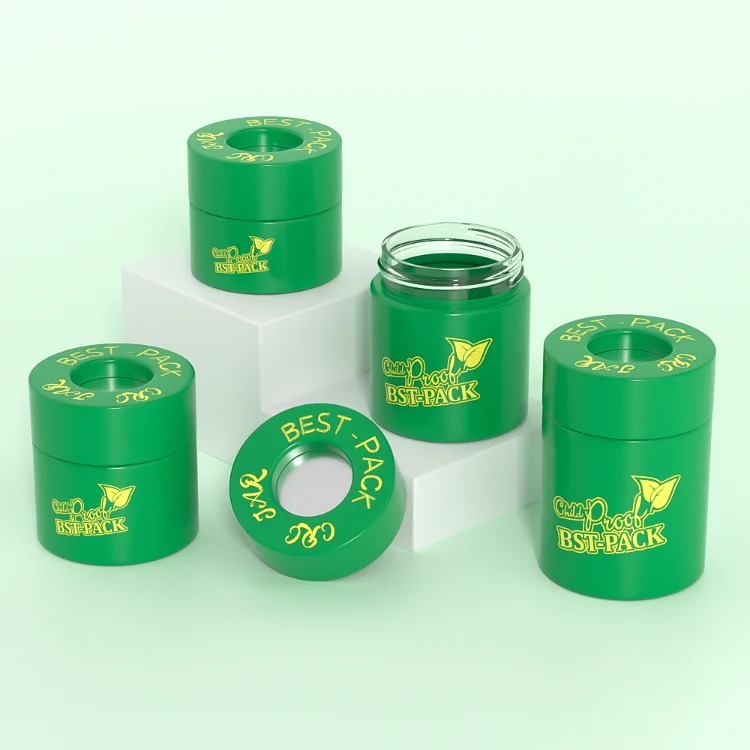
Which jar styles suit 3.5g, 7g, 14g, and 28g?
Start by comparing compact jars for 3.5g and medium-sized jars for 7g; for 14g and 28g, compare progressively wider and larger jars. The fluid-ounce figures below are supplier references for selecting samples, not universal standards for each weight.
| Flower weight | Sample-selection reference | Jar style to compare first |
|---|---|---|
| 3.5g | Approximately 2–4 fl oz | Compact straight-sided jar with an opening wide enough for larger buds |
| 7g | Approximately 4–6 fl oz | Medium wide-mouth jar that supports easy filling and removal |
| 14g | Approximately 9 fl oz as a reference | Larger jar that is relatively wide without being too deep |
| 28g | Approximately 19 fl oz as a reference | Extra-large jar that is easy to access and has a stable base |
Why do the reference figures differ? For 3.5g, Sana Packaging suggests starting with 2–3 fl oz jars, while Berlin Packaging lists 4 fl oz in its reference chart. Berlin’s chart also lists approximately 6, 9, and 19 fl oz for 7g, 14g, and 28g respectively. These figures help buyers decide which sample jars to compare; they do not replace a test fill with the actual product.
Why compare jar shapes when the volume is the same?
The same volume can come in jars with different opening widths, shoulder shapes, and heights. A jar may have enough interior space, yet an opening that is too narrow can make larger buds difficult to insert; a jar that is too deep can make flower at the bottom hard to remove.
When comparing candidate jars, check each of these dimensions:
- Opening diameter: Can larger buds pass through naturally?
- Internal width and height: Can the target weight fit without compressing the flower?
- External diameter and height: How will the finished package look on a shelf, and how many jars will fit in a case?
Do not choose based only on descriptions such as “wide-mouth” or “large-capacity.” Ask the supplier for the actual dimensions, then compare samples to see whether consumers can easily put flower in and take it out.
Do the four weight options require four different jars?
Not necessarily, but the fit should be checked separately for each weight. You can compare different sizes within one jar range or consider using one jar for adjacent weights, provided the smaller fill does not look excessively sparse and the larger fill does not require the flower to be compressed.
Using fewer jar styles can simplify inventory, but it does not always reduce total costs. If a shared jar adds unnecessary material, case-packing, or shipping costs to the smaller pack size, separate jars may be the better choice. Compare the packaging cost per finished unit, not just the price of an empty jar.
How do you determine the final size?
Fill candidate jars with the flower you plan to sell, and check whether both larger and smaller buds fit naturally and are easy to remove. Then compare the appearance of the finished packages, the number of units per case, and shipping weight to choose a size that works consistently for that retail pack.
Supplier capacity charts narrow the sample selection; the actual flower, jar design, and finished-package cost determine the final purchasing specification.