When purchasing weed storage jars, test the complete package that will be sold: the jar, lid, gasket or liner, and any induction seal used. Testing should cover the initial seal, the condition after shipping, and the condition after the consumer recloses the jar. The feel of an empty jar or a supplier’s “smell-proof” claim is not enough to establish actual performance.
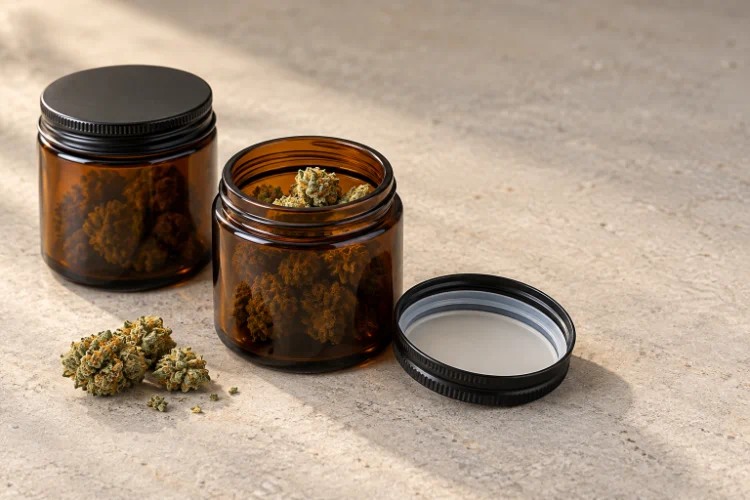
Are airtightness and odor containment the same thing?
No. A leak test checks whether a package leaks under specified conditions; an odor test checks whether substances released by the flower can be smelled or detected outside the jar. Moisture protection, light protection, and shelf-life performance must also be verified separately. None can be inferred from a single test result.
Test conclusions apply to a specific combination of jar, lid, and liner. If the supplier changes a component or the closing method, the original results may no longer apply.
Where are weed storage jars most likely to leak odor?
Check the junction between the jar rim and lid first. Variations in rim dimensions, poor thread fit, insufficient compression of the gasket, or a displaced liner can all affect package integrity.
The inspection must also distinguish a leaking package from contamination on its exterior. Flower fragments left on the rim during filling may prevent proper closure; flower left on the outside of the jar may produce a misleading odor-test result. Before testing, clean the rim and exterior using a consistent procedure, and record any damage or deformation of the gasket.
If the product uses a single-use induction seal, test both the unopened package and the jar after the seal has been removed and the lid reclosed. Passing the first test does not mean the consumer will get the same odor containment after opening.
How can you verify the actual performance of weed storage jars?
Use three steps: inspect the structure, test with the intended fill, and simulate use. Set control samples and a recording method for each step. The flower’s odor intensity, fill weight, and remaining headspace can affect the results, so sample conditions should closely match the product that will go to market.
Step 1: Inspect the production-intent package
Make samples using the jar, lid, gasket, and induction seal intended for production. Confirm component models, dimensions, and batches. Check that the rim is even, the gasket fits properly, and the lid closes consistently using the specified method.
An empty-jar inspection can reveal obvious fit problems, but it cannot, on its own, establish odor containment after filling. Check the sample models listed in any report supplied by the vendor; a report for a different lid or liner cannot be applied directly to the combination under review.
Step 2: Fill and close the jar as it will be sold
Test with the flower, fill weight, and sealing process intended for sale. Prepare empty-jar controls, clean the exterior of every jar, and use the same closing procedure, storage conditions, and observation times.
A human smell assessment can help compare samples, but results are affected by the tester, ambient odors, and the flower itself. It is suitable for initial screening. If the brand plans to make a specific odor-containment claim in marketing materials, agree on the test article, method, and acceptance criteria with a testing laboratory first, then word the claim according to the results.
If further investigation of package leakage is needed, discuss a method suitable for the complete rigid package with the laboratory. For example, ASTM F2338 covers vacuum-decay leak detection for rigid, nonporous packages. It measures leakage under specified conditions; it is not direct proof that a package releases no odor.
Step 3: Simulate shipping and repeated use
After simulating actual shipping conditions and a predetermined number of opening and closing cycles, repeat the package-integrity and odor-containment checks. Look for a loosened lid, a displaced gasket, and any difference between the results after reclosing and those from the initial seal.
The brand should set shipping conditions and the number of cycles according to its sales channels and expected use, then document them in the test plan. Do not treat the initial sealing result from a new sample as the result for its entire period of use.
How should acceptance criteria for weed storage jars be set?
Agree on the test conditions, pass criteria, and production checks before sampling begins. Otherwise, “no odor detected” may simply reflect different people making subjective judgments in different environments.
| Item | What to specify |
|---|---|
| Package components | Models of the jar, lid, gasket, and induction seal |
| Filling conditions | Flower batch, fill weight, remaining headspace, and cleaning steps |
| Sealing conditions | Closing method, induction-sealing process, and operating requirements |
| Test stages | Unopened, after shipping, and after seal removal and reclosing |
| Assessment method | Control samples, test method, observation times, and pass criteria |
| Production checks | Sampling method, record requirements, and handling of nonconforming units |
Water-resistance, smell assessments, and leak tests answer different questions. Buyers should choose tests based on the performance their product requires, rather than use one result to describe every aspect of performance.
What documents should you request from the supplier?
Request drawings, component material information, test reports, and production quality-control records that match the product to be delivered. The reports should identify which package combination was tested, how it was sealed, and the conditions under which the conclusions were reached.
The contract or specification should also define a change-notification process. If the lid, gasket, material, critical dimensions, or sealing process changes, both parties should assess whether retesting is needed. If the jar will serve as retail packaging, check the other requirements of the market where it will be sold. For example, New York State requires cannabis retail packaging to be tamper-evident and sealed to reduce oxygen exposure and product degradation; odor testing does not replace those checks.
Purchasing conclusion
A credible odor-containment conclusion comes from testing the same complete package intended for production, with the actual fill, after shipping, and after opening and reclosing. Buyers can put the agreed test conditions in the product specification, use the same criteria to inspect production batches, and describe product performance according to the evidence obtained.
Contact Easyjar for more information, a tailored quote, and free samples to test with your product. Share your target market, fill weight, and preferred jar and lid so we can recommend a suitable packaging combination.