Most discussions about storage containers stop at “UV blocking or not”, but in real industrial practice, the choice of container affects chemical stability, sensory quality, regulatory compliance, cleaning efficiency, brand positioning, and long-term operating cost. From a systems engineering perspective, UV glass jars represent not just a packaging upgrade, but a storage risk management solution.
Material-Level Performance Differences
At the material science level, the essential difference is not glass vs plastic, but optical selectivity and chemical inertness.
While ordinary glass is chemically stable, it is optically transparent to UVA, which is precisely the wavelength range that accelerates terpene oxidation and cannabinoid degradation. Silicone and plastic containers introduce an even more complex problem:
- They adsorb terpenes and oils, causing long-term aroma loss
- They release trace organic compounds over time
- They cannot be fully cleaned, leading to cross-batch contamination risks
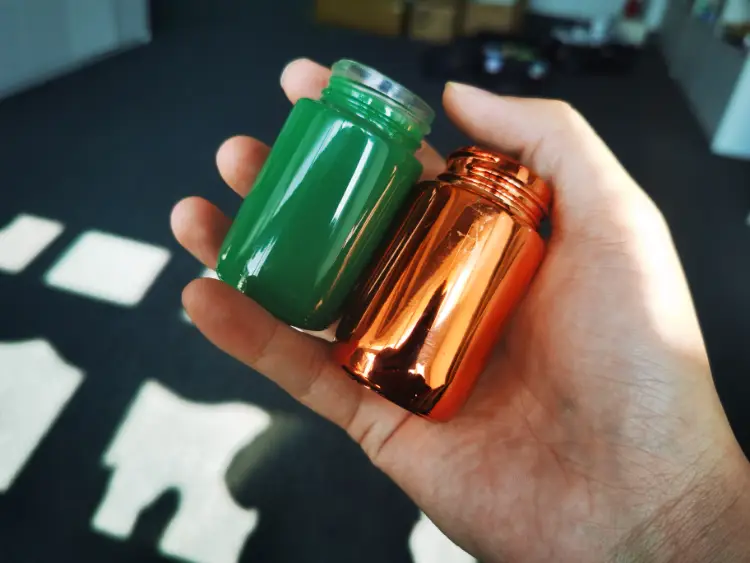
UV borosilicate glass, by contrast, is both chemically inert and optically selective, meaning it neither reacts with the product nor allows destructive photon energy to reach it. In pharmaceutical-grade storage logic, this is the minimum acceptable standard, not a premium feature.
Structural and Functional Design Evolution
Modern UV glass jars are no longer just “containers”, but functional storage systems.
Multi-compartment designs are not simply for convenience; they are critical for:
- Preventing terpene cross-contamination
- Maintaining strain-specific chemical profiles
- Supporting laboratory sample management and batch traceability
Activated carbon layers in lids are also not cosmetic features. They solve a real industrial problem:
Volatile terpene molecules do not just leak out — they also alter the internal equilibrium of the product over time.
By controlling vapor-phase migration, these systems help preserve both potency and sensory identity, which is essential for premium extract brands.
Storage Strategy Is a Regulatory and Risk-Control Decision
In professional cannabis storage, the container is part of the compliance system, not just a package.
Medical and Pharmaceutical Use
In medical markets, storage containers must simultaneously satisfy:
- Child-resistant regulations (CPSC / CR standards)
- Pharmaceutical-grade cleanliness
- Long-term chemical stability requirements
Failure in any of these areas does not just degrade product quality — it creates regulatory and legal exposure.
UV glass jars with certified child-resistant closures effectively become a passive safety device, reducing both misuse risk and compliance cost.
Home and Long-Term Storage
For long-term storage, the enemy is not only light, but also:
- Oxygen
- Moisture
- Temperature fluctuation
Borosilicate glass combined with vacuum or high-integrity sealing systems forms a micro-environment control unit, not merely a container. Its low thermal expansion coefficient ensures that seal integrity remains stable across seasons and transport conditions.
Travel and Distribution
During logistics and personal transport, mechanical shock and pressure change become dominant risks.
Composite designs using UV glass + silicone shock buffers convert a fragile chemical storage problem into a transport-grade packaging solution, significantly reducing breakage, leakage, and contamination incidents.
Why UV Protection Is a Universal Chemical Stability Tool
The relevance of UV glass jars far exceeds cannabis.
From a chemistry perspective, any product containing terpenes, essential oils, aromatic esters, or conjugated double bonds is UV-sensitive. This includes:
- Essential oils
- Perfumes
- Active cosmetic formulations
- Nutraceutical concentrates
In these industries, UV protection is no longer considered “premium packaging”, but a baseline quality assurance measure.
The shift toward UV-protected cosmetic packaging in Europe and Japan reflects a broader industry consensus:
If you invest in high-value active ingredients, but store them in UV-transparent containers, you are systematically destroying your own product.
Compliance Is a Cost-Control Tool, Not Just a Legal Requirement
Many companies treat certification as a marketing badge. In reality, it is a risk transfer mechanism.
FDA, CE, and equivalent standards exist to:
- Reduce material migration risk
- Control long-term toxicity uncertainty
- Ensure mechanical and thermal reliability under real-world conditions
Borosilicate glass surviving -196°C to 300°C thermal shock is not an academic feature. It means:
- Lower breakage rates
- Lower logistics losses
- Lower insurance and recall risk
Over a multi-year operation cycle, these factors outweigh the initial container cost many times over.
Why UV Glass Is Financially Rational, Not a Luxury
Looking only at unit price is a procurement-level mistake. The correct metric is:
Cost per preserved active unit over time
When UV glass reduces:
- Potency loss
- Product returns
- Customer complaints
- Batch downgrades
- Regulatory incidents
…it directly increases sellable yield and brand reliability.
For medical-grade extracts and premium concentrates, the container often costs less than 1–3% of the product value, yet controls 20–40% of the quality risk.
That is not an expense. That is risk engineering.
How to Think Like a Storage System Designer
A professional buyer should not ask:
“Is this jar good?”
They should ask:
“What failure modes does this system eliminate?”
Key evaluation dimensions:
- Does it block UV across UVA + UVB?
- Does it control oxygen ingress quantitatively?
- Is the material proven inert over years, not weeks?
- Does the closure system maintain performance after 100+ cycles?
- Is the supplier certification-backed or marketing-backed?
Capacity is a logistical parameter.
Stability and predictability are engineering parameters.
Conclusion
UV glass jars are not merely an upgraded container choice, but a comprehensive chemical stability management solution that integrates optical control, material inertness, mechanical protection, regulatory compliance, and long-term economic efficiency. For any product whose value depends on molecular integrity—whether cannabis extracts, essential oils, or active cosmetic formulations—UV-protected borosilicate glass should be regarded not as a premium option, but as the baseline infrastructure for quality assurance, risk control, and brand credibility in a professional market.